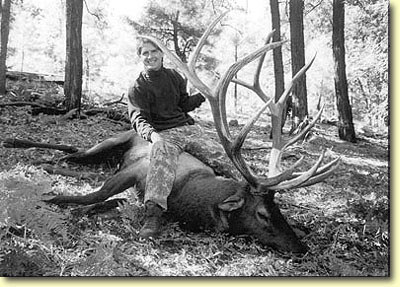
bulls to take this net 387 6/8 trophy. |
John Cardwell is the type of person who keeps himself physically fit. This year, John brought his brother James; talk about good people, some of the nicest you'll ever meet. This was James' first trip here, so when we had a chance, we gave James a "Show Me" tour. We also had a trainee guide with us. Merle Baha was our "Bird Dog", another nice guy. Merle is employed by the Game and Fish Department, and is a tribal member.
The four of us sounded like a herd of buffalo chasing elk. As it turned out, this was one of the most fun hunts we'd had in a long time.
We'd been hunting for three days; it'd been a good hunt. We'd been seeing good bulls, 15, 20, even up to 30 bulls in a day. We even ran into a herd of elk with two herd bulls battling over cows. We tried to get closer to the fighting bulls, but kept at a safe distance because the bulls might charge.
As we ran toward the battling bulls, we covered ourselves behind tall Ponderosa pine and Douglas fir trees. The cows around us stood confused or curious a few yards away. Young bulls were running toward the battle, looking for an opportunity to steal a cow. The elk were so caught up in the rut it seemed like they didn't care about us being there. Moving toward them, we got within 20 yards of the fight and sat and watched the battle of the century. This fight lasted about 3 to 5 minutes. At the same time, other bull elk around us were bugling, cows were chirping and the sound of racks from the battling bulls hitting together was awesome and unreal. The excitement was at an all-time high. You had to pinch yourself to see if you were really there.
To be able to see this in the wild is a once-in-a-life-time chance for most people. Those who never will see this are missing out on one of nature's most thrilling moments.
As it turned out, these were not the trophy bulls we were looking for. For most of the hunt, we were seeing very large bulls, but not the trophies.
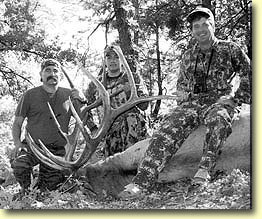
and James Cardwell with John's bull. |
Monday morning, the third day of the hunt, the four of us bailed off of a very steep ridge into the Tonto Creek drainage. Our footing was bad. We spent more time on our behinds than on our feet. I'm sure all the elk across the canyon knew we were coming. We reached the bottom after a long struggle down off the ridge. We were lucky to hear the elk were still there. In the bottom of a canyon, the echoes of a bugling elk can play tricks on your ears. We heard about three bulls at the top of the ridge in the direction we were headed. As the elk bugled and the echoes sounded, three elk would sound like six.
We decided to go down the canyon and work our way back up so we would be walking into the wind. After going a short distance, we came to a confluence of two steep canyons. I decided to have Merle and James go up the short ridge to the south and work their way back to the truck. John and I proceeded up the next ridge to the west. When we reached the top we saw one small bull, a 6x6, which would score about 340 B&C points.
We heard more bulls to the west, across the canyon, and decided to continue. We figured, what's one more canyon and one more ridge; we must have been up and down a thousand of them in the past few days. We decided to contour along the ridge, moving north around the head of the drainage, then work our way back south down the ridge to the truck which was three to four miles away.
About six bulls could be heard bugling along the ridge that we had planned to check out. As we reached the crest of the ridge we heard a bull not more than 50 yards away. We stopped for a moment to catch our breath. I moved forward just enough to see the bull. It was huge! I backed off and had John move up. He also looked at the bull. John asked what I thought it might score. The bull was so symmetrical, a typical 6x6. The inside spread I thought was not that great, but it had long main beams. So I told John, I thought it would go 375. It was a tough decision to make, but after a long talk John decided to take the bull.
The elk started moving away and down off the ridge to the north. We moved into position. Just before the bull started to bail off, John smiled at me again and asked, "What do you think the bull will score?" My reply was the same, 375. John shouldered his rifle and sighted on the bull. One shot to the lungs dropped the elk in its tracks.
As it turned out the inside spread measured 39 4/8 and the main beams were just over 52" on both sides. The gross score was 392 4/8 and the net score and final score was 387 6/8, typical. Congratulations, to John Cardwell.
And who was to know a week later, three ridges to the east, only a mile as the crow flies, Allen Hamberlin would kill the pending #2 elk in the world and the biggest bull of his life.
Someone once asked me for my opinion about the size of our elk on the reservation. My reply was, "It's not just because of good management by previous managers and current, but also because of the large amounts of prescribed burning that is conducted annually." The area where these trophy bulls were taken had been prescribed burned two years earlier by the BIA Forestry. The area had excellent vegetation with lots of new growth in the browse and grass.
The "Bureau of Indian Affairs, Fire Management Branch" has been conducting these burns since the early 1940s. The Fort Apache Agency conducts one of the largest prescribed burn programs in the country, next to the Gila National Forest in New Mexico. I feel that the prescribed burns play a large part in the growth of the elks' antlers. Prescribed burns provide new growth that is rich in nutrients and minerals elk thrive on. It is interesting that both the Fort Apache and San Carlos Indian Reservations in Arizona have the largest bull elk in the world and both of these reservations practice extensive prescribed burning.
Written by Ralph J. Thomas
Click-a-Pic ... Details & Bigger Photos
Click-a-Pic ... Details & Bigger Photos
Videos | Hunts & Tags | About Mule Deer | About Elk
Classified Ads | Photo Tours | About this Site | Advertising |
Older Content | Email Us | Privacy Policy